Powering smarter packaging decisions.

The global platform for credible, comparable recycling data for packaging, to help you focus action and investment, prepare for evolving requirements and report with confidence. 

Co-led by Systemiq and Earth Action, supported by a global coalition of partners and funders.

A pack can be designed to be recyclable and still perform poorly in practice.  

Design, investment, compliance and reporting decisions increasingly depend on what is actually recycled in each market and format. Yet packaging data today is fragmented and inconsistent, leaving teams with large gaps in usable data.  

The Packaging Data Hub brings more than 100 public and proprietary sources together in one harmonised dataset for plastic packaging, built on shared definitions and common metrics, so you can compare markets and formats on the same basis. 

What is in the Packaging Data Hub today?

50 countries already available

12 plastic packaging formats, mapped to the Ellen MacArthur Foundation Global Commitment taxonomy (9 rigid, 3 flexible)

Years: 2019 to 2025, depending on the country

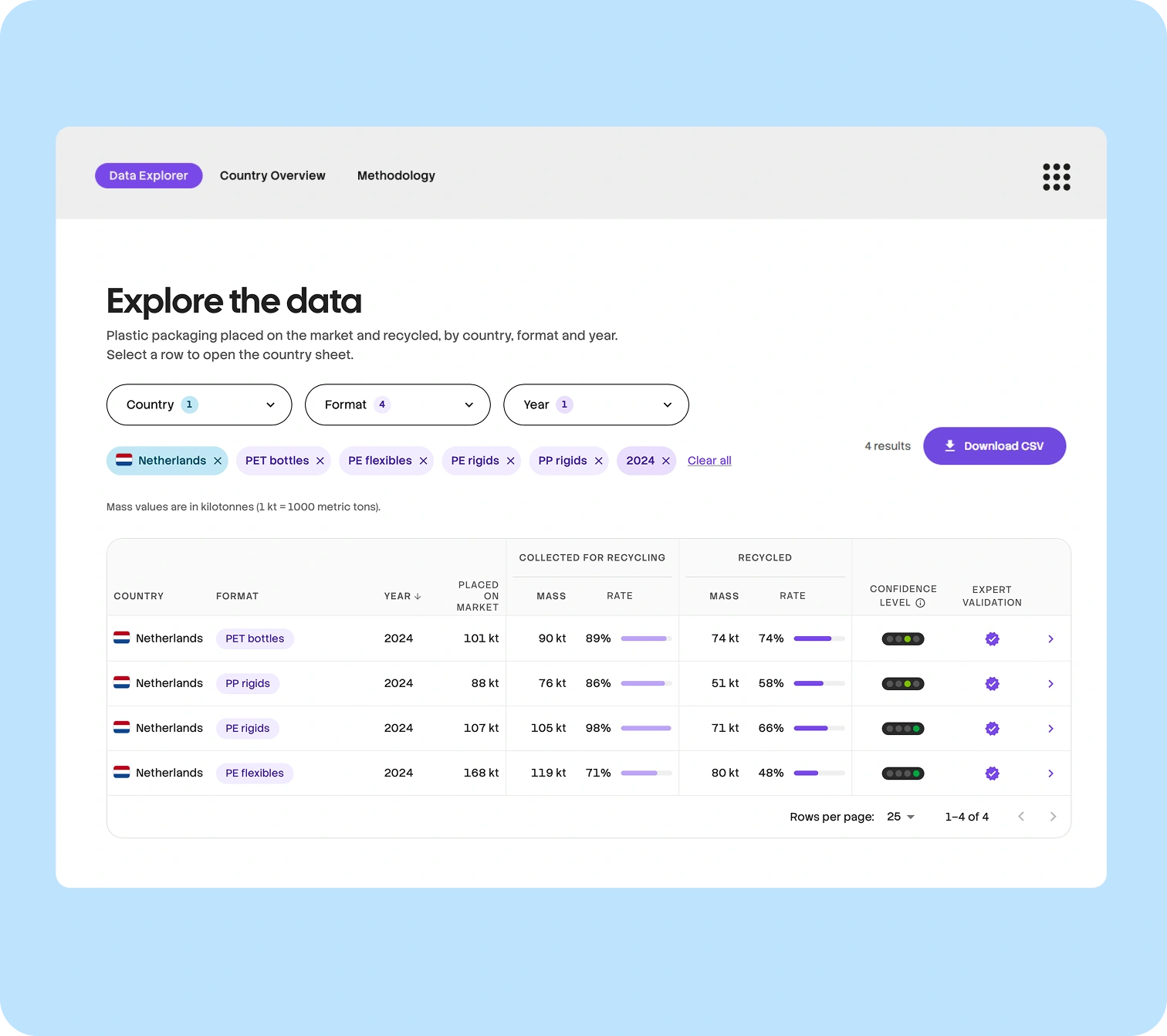
Metrics: Placed on the market, collected for recycling and recycled in practice

Features: Search, filter, compare and download data by market and format, with sources, assumptions and a confidence level for every figure

Planned for 2027

More markets including US state-level data, paper and cardboard packaging, end-of-life pathways (landfill, incineration and mismanaged waste) and forecasts of collection and recycling rates.

Focus action and investment where it matters most 

Compare real-world recycling performance across markets and formats to identify where to act first. 


The same material or format can perform very differently from one market to another, and headline recycling rates rarely show where material is lost.  
Use the Packaging Data Hub to compare formats and markets side by side, see whether losses happen at collection or later, and track progress since 2019. 

Get ahead of future compliance requirements  

See where current recycling performance may need earlier attention as new regulations take shape. 

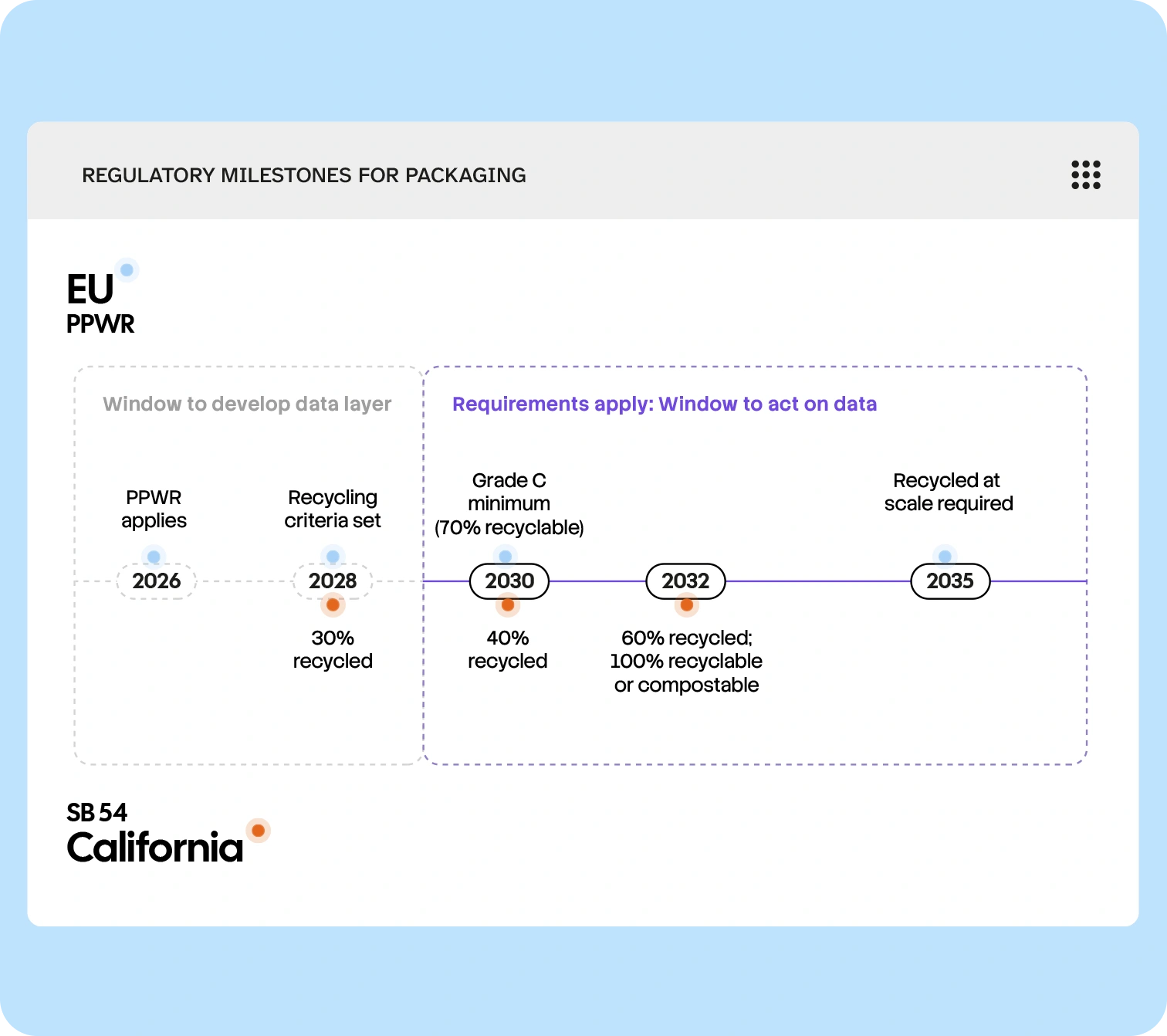
The EU Packaging and Packaging Waste Regulation (PPWR) and California’s Senate Bill 54 (SB 54) will place growing emphasis on whether packaging is recycled in practice. Today’s packaging choices will still be in your portfolio when the new rules apply.  

Check current performance for the formats and markets you sell into, decide what to investigate first and build a stronger evidence base to prepare early, alongside your regulatory analysis. 

Report figures that stand up to scrutiny 

Use figures you can explain and defend with confidence, while reducing time spent sourcing and reconciling data. 

Different definitions and data sources can give different answers for the same market and format, so teams spend each reporting cycle aligning numbers that are hard to trace back to their source.


The Packaging Data Hub gives you one consistent evidence base: every figure is harmonised across markets and formats, with its sources and confidence level visible, so you can see where it comes from and how reliable it is. 
 
The same evidence can support CDP, the Ellen MacArthur Foundation Global Commitment, Scope 3.12, mandatory disclosures and assurance. 

What our partners say

Get started with the Packaging Data Hub 

For companies

A subscription gives you access to the full platform: country and format data from 2019 to 2025 (depending on the country), with sources, assumptions and a confidence level for every figure, ready to download.  


Best for brand owners, retailers, packaging manufacturers, recyclers and waste management companies, consultants and investors. 

For non-commercial use 

Academic institutions and policymakers receive free access to the full platform for non-commercial use. Other independent non-commercial organisations can apply.  

Complete the form to explore a free sample country and receive an aggregated dataset.  

About

A global platform for credible, comparable packaging data. 

The Packaging Data Hub is a new, shared evidence base on what happens to plastic packaging after use. 

It harmonises data from a wide range of public and proprietary sources using common definitions and metrics, strengthened by data-sharing partnerships and expert review in priority markets.  


Co-led by Systemiq and Earth Action the Packaging Data Hub helps close packaging data gaps and speed up progress towards circularity. 


It combines global reach with local expertise, and its coverage will keep growing with more countries, materials and metrics.  

Developed with industry, governed in coalition 

A Steering Committee of NGOs and industry bodies provides strategic oversight. Companies from across the packaging value chain help shape and test the Packaging Data Hub through its Technical Advisory Board. 


Talk to us about partnering or funding

Steering Committee

Corporate partners

Our corporate partners are joined on the Technical Advisory Board
 by Mars, Nestlé and others, who contribute their technical expertise.

THIS PROJECT IS MADE POSSIBLE THANKS TO THE GENEROUS SUPPORT OF

News and insights

Thought leadership and perspectives from across the value chain on what it takes to build credible packaging data foundations.

Frequently asked questions

What is the Packaging Data Hub?

The Packaging Data Hub is a global platform for credible, comparable recycling data for plastic packaging. It shows how packaging performs after use in each market, helping companies focus circularity action and investment, prepare for evolving regulatory requirements and report with confidence.

Packaging decisions increasingly depend on what happens to a pack after use, not only on whether it is designed to be recyclable. Yet recycling performance varies by market and format, and the data behind it is fragmented, inconsistent and hard to compare or defend. That makes it harder for companies to decide where to act, for policymakers to set targets and for investors to see where infrastructure is most needed. With a shared evidence base that everyone can trust, companies, governments and investors can direct effort and money to what actually reduces packaging waste and pollution.

The Packaging Data Hub is built mainly for FMCG companies, retailers and packaging producers, and for the teams who make or defend decisions about packaging, from manager to board level. That includes packaging, sustainability, design, compliance and reporting leads.


It is also designed for use beyond industry. Policymakers and regulators can compare collection and recycling performance across countries and packaging formats when shaping policy. Researchers and civil society organisations can use harmonised, sourced data to study material flows and track progress against policy targets and industry commitments over time.

Companies access the Packaging Data Hub through an annual subscription to the full platform. Talk to the team to see what the platform offers before subscribing. They can give you a full demo, discuss pricing options and share aggregate data for free. Company subscriptions sustain the platform, which makes free access possible.

Academic institutions and policymakers receive free access to the full platform for non-commercial use. Requests from other organisations will be considered on a case-by-case basis. Complete the contact form to enquire and receive an aggregated dataset. You can also explore a free sample country.

The Packaging Data Hub is co-led by Systemiq and Earth Action. Its Steering Committee provides strategic oversight and brings together the Ellen MacArthur Foundation, WWF, CDP, WRAP, the Global Plastic Action Partnership and The Consumer Goods Forum. Corporate partners Amcor and Colgate-Palmolive helped shape and test the Packaging Data Hub through its Technical Advisory Board, alongside Mars, Nestlé, Unilever and others. Funding support comes from EIT Food and the Röchling Foundation.

From November 2026, subscribers can access recycling data for plastic packaging in 50 countries, for years from 2019 to 2025 depending on the country. Data is split into 12 packaging formats mapped to the Ellen MacArthur Foundation Global Commitment taxonomy: nine rigid formats, such as PET bottles and PP rigids, and three flexible formats. For each market and format, you can see how much was placed on the market, how much was collected for recycling and how much was recycled in practice. You can search, filter, compare and download the data, and every figure comes with a confidence level and its sources. Read the full list of formats and the methodology.

In 2027, we plan to expand the Packaging Data Hub to cover more markets, packaging materials and metrics. This includes adding US state-level data, coverage of paper and cardboard packaging, and introducing metrics such as end-of-life pathways (landfill, incineration and mismanaged waste). We also plan to introduce future forecasts to help users understand how packaging collection and recycling rates could evolve over time.


Throughout the year, we will continue to improve data quality and coverage through partnerships with producer responsibility organisations, recyclers and technology providers. The timing and scope of new features will depend on data availability and development priorities.

The Packaging Data Hub is built on a material flow analysis model derived from Earth Action’s Plasteax, so every tonne placed on the market is assigned an end-of-life fate. It draws on more than 100 vetted sources, including global datasets, industry and NGO reports and academic studies. Data partnerships with producer responsibility organisations (PROs), recyclers, materials recovery facilities and other operators add evidence which is often not publicly available.

All source figures are mapped to common definitions, and recycling figures measured at different points in the chain are converted to output recyclate, the material that actually leaves the recycling process. Each source is scored for quality, based on how recent, market-specific, transparent and detailed it is, and the stronger evidence takes priority. Where sources are equally reliable, the model takes the more conservative value. Where data is missing, the model still has to account for every tonne placed on the market, so it estimates the figure and gives it a lower confidence level.

Every figure comes with a confidence level (high, good, moderate or limited) which reflects both the quality of its sources and how much the model had to estimate, and its sources and assumptions are visible. In priority markets, an independent in-country expert has also reviewed the results, and those figures show an expert-validated badge. A Technical Advisory Board of consumer goods companies and a packaging manufacturer reviews and challenges the methodology, from data sourcing and validation to the final datasets before publication. Read the full methodology.

Data is updated annually, incorporating updated and improved sources, and more recent datapoints where available. Previous versions of the dataset are captured in the platform change log, and updates are clearly labelled.


Yes. The same underlying evidence can support CDP, the Ellen MacArthur Foundation Global Commitment and other voluntary reporting, Scope 3.12 emissions from the end-of-life treatment of sold products, mandatory sustainability disclosures, and audit and assurance processes. Common definitions and metrics keep figures consistent across markets and reporting uses. Sources and assumptions are visible and every figure carries a data quality score, so you can explain and defend where your numbers come from. Downloadable, structured data also cuts the time spent sourcing, cleaning and reconciling datasets each reporting cycle.

Yes. The EU Packaging and Packaging Waste Regulation (PPWR) and California’s SB 54 place growing weight on whether packaging is recycled in practice, with key milestones between 2028 and 2035. The Packaging Data Hub lets you compare current recycling performance across the markets and formats in your portfolio, so you can see where earlier attention may be needed and decide what to investigate first. It complements detailed regulatory analysis and does not replace it.

Guidelines such as RecyClass in Europe and those of the Association of Plastic Recyclers (APR) in the United States assess whether a pack is designed to be recyclable. The Packaging Data Hub reports what happens to packaging after use: how much is collected and recycled in each market. A pack can meet design guidelines and still be recycled at low rates where collection or sorting is weak, so the two views work best together. It does not assess individual pack designs.