Systemiq and Earth Action have today (11 November 2026) launched a new data platform to tackle gaps in packaging recycling data, backed by corporate partners including Amcor and Colgate-Palmolive.
As businesses look for evidence of whether their packaging is recycled in practice, the Packaging Data Hub addresses the persistent challenge with recycling figures drawn from different sources. These often use different definitions, making it complex to compare performance between markets or identify where investment is most needed.
Based on the data currently in the Hub, approximately 18% of plastic packaging is recycled in practice across the 50 countries it covers, which together account for around 80% of the world’s plastic packaging waste.
Across these markets, flexible packaging makes up around 40% of plastic packaging waste, yet only around 10% is currently recycled. In low- and middle-income countries, recycling rates are around twice as high where EPR schemes are in place.
The EU recycles around 35% of its plastic packaging, against a 2030 mandatory target of 55% under the PPWR. The Hub counts only plastic that comes out of the recycling process as usable material, after losses at collection and sorting, which is why it sits below official EU figures.
With recycling requirements increasing, data gaps risk leaving businesses facing expensive redesigns, misdirected investment and reporting figures they cannot confidently defend.
The platform brings together harmonised, comparable data on 50 countries and 12 plastic packaging formats, giving companies, policymakers, investors and environmental organisations a shared picture of what happens to packaging after use.
The vision is for the Packaging Data Hub to become a trusted source of data that all stakeholders can use to make better packaging decisions, and a critical enabler of the transition to a circular economy.
Corporate partners Amcor and Colgate-Palmolive helped shape, test and validate the methodology behind the Packaging Data Hub through its Technical Advisory Board, alongside Mars, Nestlé, Unilever and others.
Strategic oversight comes from a Steering Committee comprising the Ellen MacArthur Foundation, WWF, CDP, WRAP, the Global Plastic Action Partnership and The Consumer Goods Forum, whose reach across the packaging system will help establish the Hub as a shared source of credible, comparable recycling data. Funding support comes from EIT Food and the Röchling Foundation.
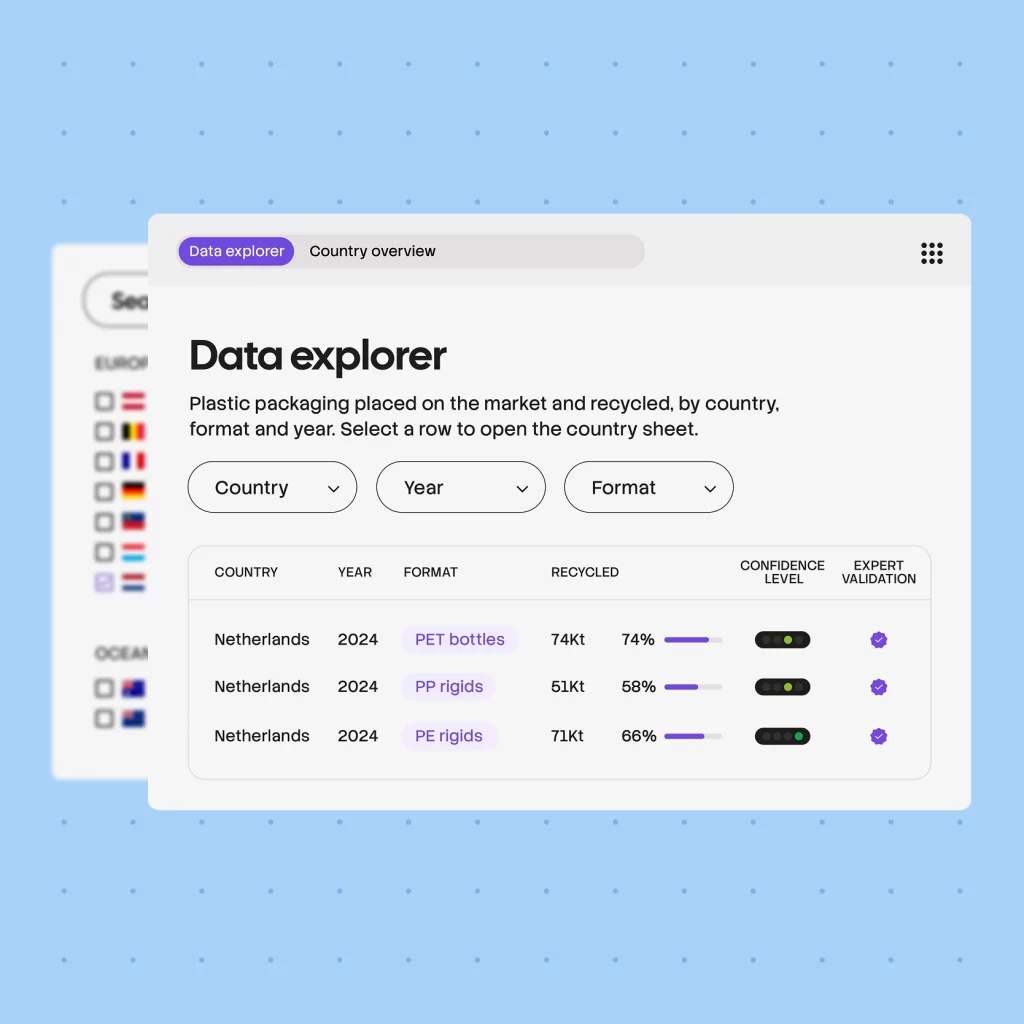
It draws on more than 100 vetted public and proprietary sources, alongside data-sharing partnerships with producer responsibility organisations, recyclers, materials recovery facilities and other operators. Each figure is shown with its sources and a confidence level, allowing users to assess the strength of the evidence.
Users can search, compare and download data by country, packaging format and year. The platform estimates the volumes of packaging entering each market, collected for recycling and recycled in practice, going beyond broad material averages to give a more detailed view of individual formats.
For packaging teams, this means being able to compare the performance of a particular format across markets, set their packaging strategy, identify where to investigate or invest, and report with figures they can explain and defend, while preparing for regulations such as the EU’s Packaging and Packaging Waste Regulation (PPWR) and California’s SB 54, and the extended producer responsibility (EPR) schemes now operating in dozens of countries.
The same data can support voluntary reporting, such as CDP and the Ellen MacArthur Foundation Global Commitment, Scope 3 calculations and ESG disclosures.
In 2027, coverage is planned to expand to more countries, including US state-level data, to paper and cardboard packaging, and to future forecasts of collection and recycling rates, with more data partnerships strengthening the evidence base.
“Better data enables better decisions. As a founding member of the Packaging Data Hub, Amcor is helping build a shared evidence base to guide packaging innovation, inform policy and target infrastructure investment where it can have the greatest impact and accelerate progress toward a circular packaging economy.”
David Clark, Chief Sustainability Officer at Amcor
“At Colgate-Palmolive, we are focused on value-creating sustainability as we reimagine a healthier future for all. As part of our 2030 strategy, we are committed to ingredient and packaging transparency. Standardizing packaging measurement across the industry is vital, which is why we are proud to support the Packaging Data Hub as a founding partner.”
Ann Tracy, Chief Sustainability Officer, Colgate-Palmolive
“Businesses and policymakers make packaging decisions using information that is often incomplete or hard to compare, which risks sending innovation, redesign and infrastructure investment in the wrong direction. The Packaging Data Hub offers a common reference point on what happens to packaging after use, with packaging formats aligned to our Global Commitment taxonomy - part of our 2030 Plastics Agenda for Business. It gives businesses and policymakers a shared evidence base to align investment and policy, and to move faster toward a circular economy.”
Rob Opsomer, Executive Lead – Plastics, the Ellen MacArthur Foundation
Packaging teams are making decisions today that will shape what reaches the market for years to come. They need to know whether a pack can be recycled, and whether the systems exist to recycle it where it is sold. Our vision is a trusted evidence base that everyone in the packaging system can use to make better decisions and move faster towards a circular economy.”
Yoni Shiran, Partner and Plastics Lead at Systemiq
“A recycling figure is only useful if you know how much confidence to place in it. Different definitions and incomplete evidence have made that harder than it should be. The Packaging Data Hub brings sources together using common definitions, taxonomy and metrics, and makes the evidence behind each figure visible.”
Julien Boucher, Co-founder and Head of Research, EA - Earth Action
Companies access the platform through a paid subscription. Policymakers, academic institutions and other independent organisations can request free access to the full platform for non-commercial use. Anyone can explore a free sample country and aggregate data.
For more information, visit www.packagingdata.earth
Media contact: ulrike.stein@systemiq.earth
Recycled in practice counts only material that leaves the recycling process as recyclate, after losses at collection and sorting. The full methodology is available at https://hub.packagingdata.earth/methodology